
Smoke odor removal
Getting the smell of smoke out of a Miami home or business after a fire: smoke odor removal, from the residue that holds it to the ducts that carry it.
When to call
- The smell is still there weeks after the cleaning
- The smell returns in hot weather
- A home or unit bought or rented from someone who smoked
- The ducts and air handler need cleaning after smoke went through them
- A unit that must be ready for a new tenant
Where the smell of smoke sits after the fire is out
If the fire department has not yet said the building is safe to enter, nobody goes in to deal with the smell: FEMA’s Ready.gov says to check with the fire department first. Inside the City of Miami that is the Department of Fire-Rescue, and in unincorporated Miami-Dade and the 29 municipalities the county department serves, Miami-Dade Fire Rescue.
The smell is not in the air alone. Texas A&M AgriLife Extension’s guide to removing smoke smell, written for homes after wildfire smoke, describes it as tiny particles that cling to walls, furniture, floors and clothing, and that get into the smallest cracks. Researchers at the University of Colorado’s CIRES institute, writing about homes reached by wildfire smoke, explain that what you smell are volatile organic compounds that condensed on walls, furniture and curtains and are now slowly given off again. Washington State’s Office of the Insurance Commissioner describes the same smell lingering in carpets, furniture and clothing.
In a condo, smoke from another unit can leave its smell in yours; what to do first in that case is set out under smoke damage in a condo.
Cleaning comes before deodorizing
The smell goes when its source goes. The Texas A&M guide, written for wildfire smoke, says the source of the problem must be removed and the particles cleaned off, and that remedies such as scented candles and perfumed sprays most often only mask the odor for a while. So the residue on walls, ceilings and fixtures is cleaned first, as described on our soot removal page, and smoke odor removal then deals with what the cleaning cannot reach.
Some material holds the smell too deeply to be cleaned. The Washington insurance commissioner’s page says soot permeates drywall, insulation and hardwood floors, which can permanently compromise the material and usually calls for professional deep cleaning, sealing or complete replacement. Material that has to come out is taken out, and putting new material in its place is repair work, described under replacing material that holds the smell. Clothes, furniture and curtains that took the smell are a contents job, which we take on as well.
Smoke odor work is one part of fire damage restoration in Miami. In a building where rooms burned, clearing the debris and the firefighting water and drying the structure come before any deodorizing, as described under the rest of the fire cleanup. What is known about fire damage costs in Miami is set out on our home page.
Ozone, hydroxyl, fogging and air scrubbing: what each method does
Restorers use several machines and treatments for the odor that is left after cleaning; what each one is, and what the public agencies say about it, follows.
Ozone. An ozone generator fills a closed space with ozone, a reactive gas meant to break down the compounds that smell. EPA’s page on ozone generators says high concentrations of ozone, when people are not present, are sometimes used to help decontaminate an unoccupied space of odors, naming fire restoration, but that little is known about the chemical by-products these processes leave behind. It says ozone can damage materials such as rubber, electrical wire coatings, and fabrics and art work with susceptible dyes. It also says there are few scientific studies to support the claim that ozone effectively removes odors, though it is plausible that some odorous chemicals react with it, and that no agency of the federal government has approved ozone generators for use in occupied spaces.
Hydroxyl generators. A hydroxyl generator makes reactive molecules, hydroxyl radicals, that are meant to break down odor compounds in the air. EPA’s indoor air filtration guidance, written for clearing wildfire smoke from the air of a home, says hydroxyl generators are not recommended for smoke removal, because they are not designed to remove particles from the air and may produce ozone or other harmful air pollutants.
EPA’s wildfire ash guidance adds a wider caution: it advises avoiding products that add chemicals to the air to remove or neutralize smoke odors, such as ozone and hydroxyl generators, or other oxidizers.
Thermal fogging. A thermal fogger heats a deodorizing solution and releases it as a fine fog into the rooms. EPA’s pages on ozone, air cleaning and ducts do not name it, but its wildfire ash caution above concerns any product that adds chemicals to the air to remove or neutralize smoke odors.
Air scrubbing. An air scrubber draws a room’s air through filters and blows it back out. The filters that matter here are a HEPA filter, a mechanical filter for particles, and activated carbon for the gases that smell: in their wildfire smoke advice, the CIRES researchers say the carbon filter is important because it removes from the air the compounds that cause the smell. Air scrubbing works on the air, not on the residue on surfaces.
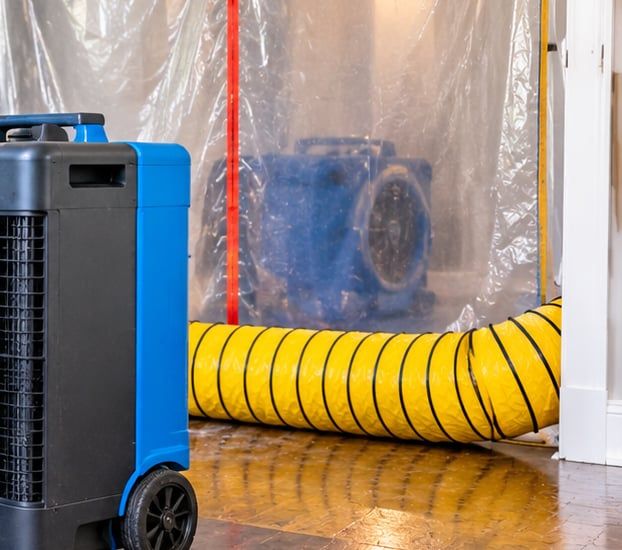
Sealing. A sealer or primer can be applied to a wall or ceiling once it has been cleaned. EPA’s advice on sealants, in the duct section below, is about the inside of ducts, not walls and ceilings.
Can you stay home during smoke odor treatment?
It depends on the method, and only for ozone does an agency say so plainly. For ozone, beyond the unoccupied use quoted above, EPA says conditions should be controlled so that no person or pet is exposed, and that ozone can harm indoor plants. The Texas A&M guide, written for wildfire smoke, likewise says using an ozone generator requires a temporary evacuation of the home. EPA’s ozone page gives the reason: when inhaled, ozone can damage the lungs. People, pets and plants are out of the space while the generator runs and until the space has been aired out afterwards. EPA gives no time for that; the CIRES researchers, in their wildfire smoke advice, say to stay out while an ozone or hydroxyl generator is operating and then to air out the home, preferably with the windows and doors open, for three hours before going back in.
For hydroxyl generators, which EPA’s wildfire smoke guidance above advises against for smoke removal, EPA gives no rule on staying in the home; the CIRES advice above, to stay out while the generator is operating and to air out for three hours, is given for hydroxyl generators as well as ozone. For thermal fogging, EPA gives no rule on staying in the home either. For air scrubbing with mechanical filters, EPA’s wildfire indoor air filtration guidance is written for people living in the home, and tells them to use only air cleaners certified by the California Air Resources Board.
Duct and air handler cleaning after smoke
We clean the ducts and the air handler after smoke has gone through them. The Washington insurance commissioner’s page explains why it matters: smoke particles circulate through the heating and air conditioning ducts, spreading soot and odors through the whole home. Whether to run the system before it has been checked is a separate question, set out on our page about running the air conditioning after smoke damage.
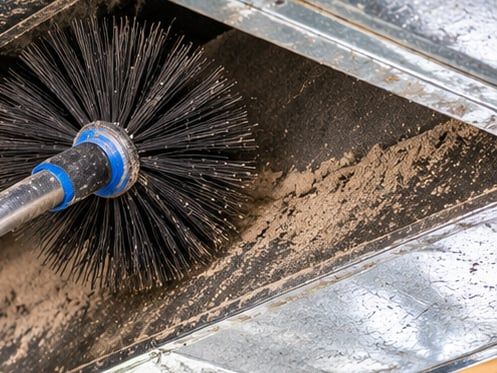
EPA’s guidance on cleaning air ducts sets out what to expect from the work:
- Duct cleaning takes in the system’s components, the air handling unit’s housing among them, and failure to clean a component of a contaminated system can re-contaminate the entire system.
- Duct cleaning has never been shown to actually prevent health problems, and EPA does not recommend cleaning ducts routinely, only as needed.
- An inadequate vacuum collection system can release more dust, dirt and other contaminants than leaving the ducts alone.
- EPA and the trade bodies do not recommend the routine use of sealants inside any type of duct. EPA names combating fire damage within ducts as a case where one may be appropriate, applied only after cleaning and never over wet duct liner, growing mold or debris, and it says little is known about the potential toxicity of these products.
- Little research shows that most biocides, or ozone, work inside ducts. No biocide is registered for use on fiberglass duct board or fiberglass-lined ducts.
Why a smoke smell comes back
A smell that seemed gone can return, and the reason is residue still in place: in a wall cavity, a duct, or a porous material the cleaning did not reach. Writing about homes after wildfire smoke, the CIRES researchers say in their advice on post-fire smoke that the compounds deposited on walls and other surfaces will likely keep off-gassing for weeks to months, and that the off-gassing depends on temperature: more is given off when it is warmer, less when it is cooler. As the duct section above notes, a part of the air system left uncleaned can carry the smell back through the whole house.
Miami has a long warm season. The National Weather Service’s Miami office, in its study of the summer season in South Florida, puts the median summer, in the Miami airport’s records from 1956 to 1997, at May 21 to October 17, warm and humid throughout. The CIRES finding is about temperature, not humidity. So a smell that returns when the building is warmer is a sign to look again for the residue, not to add another fragrance. No restorer can promise that a smell will never return.
Cigarette smoke smell removal
We take on tobacco smoke odor in homes, condos and rentals, including a home bought from a smoker or a unit between tenants. It is a different job from fire smoke. The smoke of a fire comes once; tobacco smoke builds up over years, on every surface. EPA’s page on secondhand smoke in the home says some of the chemicals released by smoking can remain indoors for a long time, building up on hard surfaces such as walls, tables and floors and embedding in clothing, upholstery, drapes, bedding and carpets, and that they can be released back into the air, which it calls thirdhand exposure. In its section on reducing exposure indoors, it adds that ventilation, filtration and air cleaning can reduce exposure to these chemicals but will not eliminate it.
The Thirdhand Smoke Resource Center, part of the California Thirdhand Smoke Research Consortium, warns that alcohol-based primers and paint may trap thirdhand smoke residue on a wall without removing its chemicals, and that carpets, upholstery and mattresses, which cannot be submerged and scrubbed, keep holding residue. So the work is cleaning first, on walls, ceilings, cabinets and the ducts, with soft furnishings that hold the residue taken out, before any deodorizing. The Center adds that once the chemicals are embedded in porous materials such as wood panels, particle board and drywall, cleaning the surface is not enough, that ozone generators do not remove chemicals embedded in materials, and that the only sure way to be rid of the residue is to remove and replace the material.
How the job goes
-
Step 1: Where the smell lives
The materials and spaces holding the smell are found, room by room, including the places out of sight that the smoke reached.
-
Step 2: What has to go
Material that holds the smell and cannot be cleaned is marked to be taken out and replaced.
-
Step 3: Cleaning first
The residue that holds the smell is cleaned off before any deodorizing begins.
-
Step 4: The air system
The ducts and the air handler the smoke passed through are cleaned along with the rooms they serve.
-
Step 5: The deodorizing
The method chosen for the building is applied in the rooms that need it, with people kept out wherever the method calls for it.
Questions
Can professional cleaners remove smoke smell?
They can take away what holds it: the residue on surfaces, the material that cannot be cleaned, the residue in the ducts, and then the odor left in the air and in what remains. Whether a smell can come back afterwards, and why, is answered in the section on why a smoke smell comes back.
How much does it cost to get rid of smoke smell?
It depends on how far the smell has gone into the building, how much material has to come out, and whether the ducts need cleaning.
Do air fresheners or paint remove smoke odor?
Not for good. A fragrance hides the smell for a while, and paint laid over residue that was never cleaned off may hide the odor for a time without removing what causes it. What holds the smell has to be cleaned off or taken out.
Had a fire? Call us.
Tell us what happened and where the building is. We will tell you on the call what happens next.
Open 24 hours, every day