
Fire damage restoration in Miami
After a fire in Miami we board up, remove the firefighting water, dry the building and clean the soot and smoke: fire damage restoration for homes and businesses, with an emergency line open 24 hours a day.
Had a fire? Call us.
Tell us what happened and where the building is. We will tell you on the call what happens next.
Open 24 hours, every day
Our services
- Board-up and roof tarpingBoard-up and roof tarping in Miami, 24 hours a day: we close the windows, doors, walls and roofs that a fire, a storm or a break-in has left open.
- Smoke damage restorationWe take on smoke damage in Miami homes and condos after a neighbor's fire, or a small fire that is already out, wherever its smoke reached.
- Soot removalWe clean the soot a fire leaves on walls, ceilings, cabinets and floors: soot removal in Miami homes, condos and businesses, surface by surface.
- Smoke odor removalGetting the smell of smoke out of a Miami home or business after a fire: smoke odor removal, from the residue that holds it to the ducts that carry it.
Where we work
- Miami, Florida
- Miami Beach, Florida
- Miami Gardens, Florida
Fountainebleau, Miami, FL 33126
What should you do first after a fire in Miami?
Stay out until the fire department that fought the fire says the building is safe. In the City of Miami that is the City’s Fire-Rescue department; in unincorporated Miami-Dade and 29 of the county’s 34 municipalities it is Miami-Dade Fire Rescue, according to a 2022 county report. Miami-Dade Fire Rescue’s After the Fire booklet, in English, Spanish and Creole, says the same, and the U.S. Fire Administration warns that floors and walls may not be as safe as they look.
Do not turn back on the power, gas or water the firefighters turned off; the U.S. Fire Administration says not to do it yourself. The booklet says a licensed electrician must assess the wiring before Florida Power and Light will reconnect, a licensed professional should turn other utilities back on, and natural or propane gas may leak.
The booklet makes securing the building the owner’s job. We board up openings and tarp the roof.
Then comes the water used on the fire. EPA says wet building materials must be dried within 24 to 48 hours to avoid mold growth; the Florida Department of Health says within 24 hours. Neither time was written for firefighting water by name, but EPA’s wildfire ash fact sheet says mold may be present if water was used to put out a structure fire. NOAA’s 1991 to 2020 normals for Miami International Airport put the average relative humidity at 73% for the year and 74 to 78% from June to September.
The booklet also says not to throw out damaged goods before a proper inventory, to hold off on cleaning valuables until the damage is assessed for insurance, and to discuss repair plans with your insurer first. That pulls against the drying times, and the booklet answers it: protect the property from further damage with reasonable and necessary repairs, take pictures and an inventory of what was damaged, and keep the receipts; ask your insurer what else it needs.
Fire damage cleanup in Miami
After a house fire, the owner arranges the cleanup. The U.S. Fire Administration’s advice is to ask your insurance company first which companies it recommends and whether you or it will pay for the cleaning. Miami-Dade Fire Rescue’s booklet names fire restoration companies as the help for restoring property after a fire (water and smoke damage, contents and cleanup), and also tells readers to check them first, as the section on checking a company sets out. We take this work in Miami in houses, condos, apartments and businesses:
- Debris. Taking out what burned and what cannot be kept.
- Water and drying. Removing the water from the hoses and drying the structure. The U.S. Fire Administration notes that things the fire did not damage may still be ruined by smoke and soaked by the water used to put it out.
- Soot. Cleaning the soot off walls, ceilings, fixtures and finishes.
- Smoke smell. Treating the smell of smoke that stays in the building and its contents.
- Ducts. Cleaning the air conditioning ducts and the air handler after smoke, with our own crew.
- Smoke in other rooms or units. Smoke that reached rooms or units the fire did not, including a unit next to the one that burned.
- Belongings. Cleaning the clothes, furniture and other belongings the smoke, soot or water reached.
Our services page sets out every fire damage job we take and which one a home or business needs first.
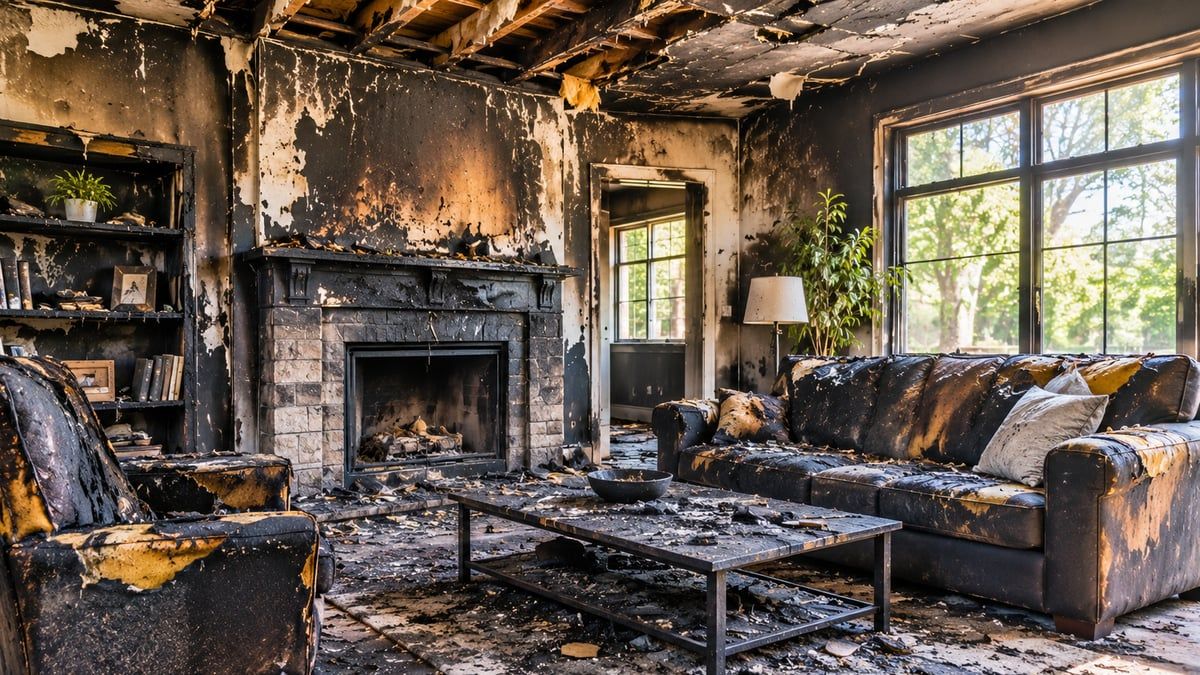
Two checks belong to other trades. The booklet advises having a licensed air conditioning repair company check the unit and ducts for soot and contaminated residue. Whatever started the fire, the booklet says not to use appliances exposed to water or steam until a licensed electrician has checked them.
Many of the City of Miami’s homes are in old or large buildings. Of its 223,826 housing units, about half were built before 1980 and 48.8% are in buildings of 20 or more units, according to the Census Bureau’s American Community Survey, 2020 to 2024. EPA’s guidance for homeowners is not to touch material you suspect contains asbestos and to have a trained and accredited asbestos professional take samples; it also says a home built before 1978 is more likely to have lead-based paint, so before renovation or repair disturbs painted surfaces, have a certified inspector or risk assessor check for it, or assume it is there.
Fire damage repair in Miami
Whether a fire-damaged building can be repaired is decided building by building, and the repair needs a building permit. Which department issues it depends on the address. Inside the City of Miami, the City’s Building Department takes every building permit application through its iBuild portal and requires an inspection at every phase of the work, according to its Building FAQs. For unincorporated Miami-Dade, the county’s permit page says a building permit is required for repairs, and that a city has its own Building Official within its limits. Unincorporated folio numbers begin with 30, which the Property Appraiser’s search shows; the City’s Interactive Maps show whether an address is inside City of Miami boundaries.
In unincorporated Miami-Dade, repairs take a master permit, possibly with separate electrical, mechanical, plumbing, roofing and window permits, and drawings signed and sealed by an architect or engineer, according to the county’s permits page. Minor repairs, within a value limit the county sets and with no structural work, can be filed with a scope-of-work list instead of plans. A property damaged by fire must first get the county Enforcement Unit’s approval to file a repair permit and to use the list, and the list also needs a supervisor’s approval. When all trade inspections have passed, a final building inspection follows. The owner may then apply for a Certificate of Occupancy or a Certificate of Completion, whichever the county issues for that work, once any completion holds are satisfied, for a fee.
Miami-Dade’s owner-builder page warns: “If a contractor tells you to get an owner-builder permit, you become legally responsible for all the work done.”
How does a fire damage job go, and how long does it take?
How long it takes depends on how far the fire, smoke and water reached and on whether a repair needs a permit; the work runs in this order:
- Clearance: the fire department says the building is safe to enter.
- Securing: openings boarded and the roof tarped.
- Inspection: what the fire, smoke and water reached, room by room.
- Water: removed, and the structure dried.
- Soot: cleaned from the surfaces it reached.
- Odor: the building and its contents deodorized.
- Contents: belongings listed, then cleaned or set aside for the claim.
- Repair: under permit, through the inspections.
On a first visit after a fire, the restorer goes through the building and writes down what the fire, smoke and water reached: each room and its materials, the air conditioning, the belongings, and any opening or wet area that cannot wait.
The permit and its inspections add time, and so does the county Enforcement Unit’s approval for a fire-damaged property, both described above.
What does fire damage restoration cost in Miami?
No public body we know of publishes what restoration work costs. A figure that is published for fires is something else: the U.S. Fire Administration’s dollar loss is a fire department’s estimate of what was lost, in replacement cost, including contents damaged by fire, smoke, water and overhaul, and not indirect loss such as business interruption. It measures the damage, not the price of the work.
For companies that clean belongings, the U.S. Fire Administration’s advice is to ask for a cost estimate in writing.
Who should you tell after a fire?
Tell your insurer. The U.S. Fire Administration says to call it right away and ask what to do first; your insurer is the one to say what your policy covers, and Miami-Dade Fire Rescue’s booklet says to keep a record of every call and meeting.
In a condo, report the damage to the association before any work starts, read your condominium’s declaration and talk to the association. If you rent, the booklet says to tell the owner or property manager as soon as possible. If the smoke came from someone else’s fire, see our page on smoke damage from a fire in a neighboring unit.
What to throw away after a fire, and is the air safe?
Miami-Dade Fire Rescue’s booklet says food, drinks and medicines exposed to heat, smoke, soot and water should not be consumed. For medicine the FDA says fire heat can weaken or destroy it, so consider replacing medicine exposed to excessive heat; a medicine needed for a life-threatening condition may be used if it looks unchanged and is not wet, when a replacement is not readily available, and should be replaced as soon as possible.
EPA’s wildfire guidance on indoor air says children, older adults and people with heart or lung disease such as asthma should not take part in cleanup work. Its wildfire ash fact sheet adds pregnant women to those who should not take part, says surgical masks and one-strap dust masks will not protect your lungs, and advises a NIOSH Approved respirator marked N95 or P100. The U.S. Fire Administration warns that the soot and dirty water left behind may contain things that could make you sick.
The booklet lists “bad air” among the hazards inside and says to keep the areas you enter well ventilated. No public agency we found publishes a test or a level that tells occupants the air is safe to live in again after a house fire; FEMA’s guide for homes that took in wildfire smoke recommends environmental testing after cleanup.
How do you check a fire restoration company in Florida?
A contractor’s license can be looked up with the state’s Department of Business and Professional Regulation.
Look at whose name a certification is in. The IICRC says its technician certifications follow the person, not the company; a Certified Firm, a business that employs one or more certified technicians, can be verified on its Global Locator or by phone.
Miami-Dade Fire Rescue’s booklet says professional restoration companies can be a great asset, and also reminds readers that they are in business to make a profit: check their references, get estimates before any work is done, use licensed professionals and keep talking to your insurance company.
About us
In Miami we take on board-up and roof tarping after fires, storms and break-ins, fire damage cleanup, smoke damage restoration, soot removal, smoke odor removal and contents cleaning, for homes and businesses. Our crew and our phone line serve customers in Spanish as well as in English.
Questions after a fire in Miami
When should I call a fire damage restoration company?
As soon as the fire is out: our line is open 24 hours a day. Calling is not going in, and nobody goes in until the fire department that fought the fire has cleared the building, as the first section explains. The drying times given there are the reason not to wait.
Can we stay in the home during the work?
Not before the fire department has said it is safe, and after that it depends on how much of the home was damaged and what the work involves. Whether your policy pays for living elsewhere is a question for your insurer.
Can smoke smell be removed completely?
Nobody can promise that. Residue the cleaning did not reach can bring the smell back, as set out under why a smoke smell comes back.
What can be saved after a fire?
Some of it, after careful cleaning: the U.S. Fire Administration says anything you want to save or reuse will need to be carefully cleaned, and Miami-Dade Fire Rescue’s booklet warns that a lot of your possessions will be beyond salvaging. List everything before deciding, as the first section explains.
How do I get the fire report?
From the department that fought the fire. For Miami-Dade Fire Rescue, its booklet says reports are available approximately seven to ten days after the incident and are requested by mail from its Central Records Bureau, with the incident date, time, location and number, a self-addressed stamped envelope and a check; the booklet gives the mailing address and the fee per certified page. The county’s records page says requests can also be made in person, and to call its records office for the total before sending a check. For City of Miami Fire-Rescue, the City’s Fire Prevention Bureau page says a fire report is obtained by making a public records request, which can be paid for online; the City gives no fee or waiting time for it there.
Had a fire? Call us.
Tell us what happened and where the building is. We will tell you on the call what happens next.
Open 24 hours, every day